

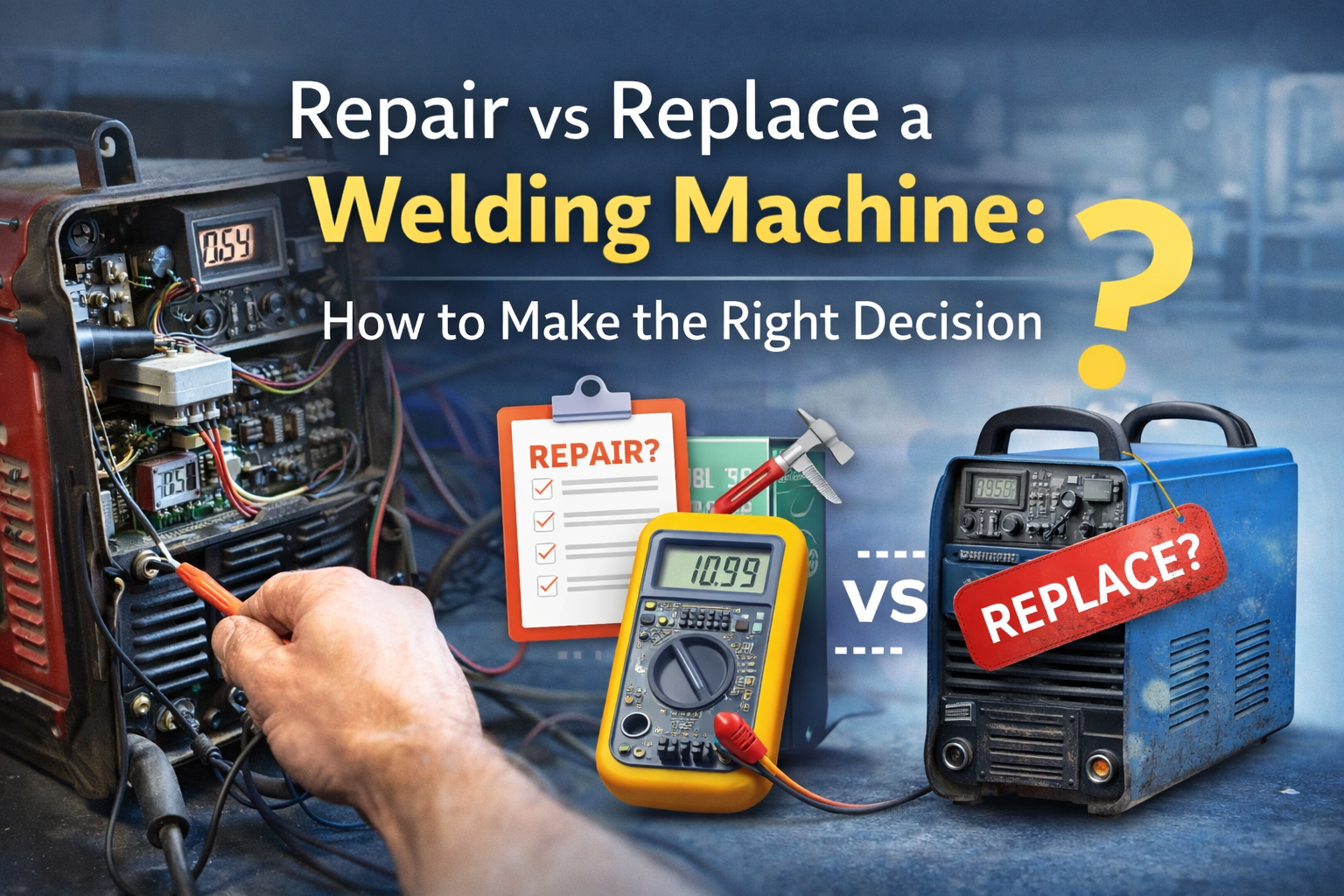
When a welding machine stops working properly, many operators face the same difficult question: should the machine be repaired, or is it time to replace it entirely?
For fabrication shops, contractors, and industrial welders, welding equipment is a critical part of daily operations. When a machine goes down, productivity can come to a halt. This often creates pressure to make a quick decision, sometimes leading businesses to replace equipment that could have been repaired at a fraction of the cost.
The reality is that many welding machines can be restored to full functionality with professional repair and maintenance. However, there are also situations where replacement is the more practical option.
Understanding the factors that influence this decision can help welders and shop owners make the right choice while minimizing downtime and unnecessary expenses.
Why Welding Machines Fail in the First Place
Welding machines are built to withstand demanding environments, but they are still complex electrical systems. Over time, exposure to heat, dust, vibration, and electrical stress can cause components to wear out.
Some of the most common causes of welding machine failure include worn power components, damaged circuit boards, overheating, and poor electrical connections. In many industrial environments, dust and metal particles accumulate inside the machine, eventually affecting cooling systems and internal electronics.
In other cases, issues arise due to inconsistent power supply, improper maintenance, or simply years of heavy use.
Fortunately, many of these problems involve components that can be repaired or replaced without the need to purchase an entirely new machine.
When Repairing a Welding Machine Makes Sense
In many situations, repairing a welding machine is the most cost-effective solution.
Modern welding equipment, especially professional models from manufacturers such as Miller, Lincoln Electric, and ESAB, is designed with serviceable components. Power modules, control boards, contactors, and cooling systems can often be repaired or replaced individually.
For machines that are only a few years old, repair is almost always the better option. Even if the issue involves a major component, the repair cost is typically far lower than the price of a new welder.
Repairing also allows operators to continue using equipment they are already familiar with. Many welders prefer sticking with machines they know well rather than switching to a completely new unit.
In addition, repair turnaround is often faster than sourcing and configuring new equipment, especially when the machine is part of a production line.
The Cost Comparison: Repair vs Replacement
One of the biggest factors in the decision process is cost.
A professional welding machine can cost anywhere from a few thousand dollars to well over ten thousand dollars depending on the model and capabilities.
By comparison, many repairs fall within a much smaller range. Replacing components such as relays, capacitors, cooling fans, or internal wiring may cost only a fraction of the price of a new machine.
Even more complex repairs, such as replacing power modules or control boards, are often significantly cheaper than replacement.
However, if multiple major components have failed simultaneously, the repair cost may begin to approach the value of the machine itself. In these situations, replacement becomes more practical.
This is why a proper diagnostic assessment is essential before making any decision.
The Age of the Welding Machine Matters
The age of the machine plays an important role in determining whether repair or replacement makes more sense.
Machines that are relatively new often have years of service life remaining, making repair a logical choice.
However, very old machines may present challenges. Replacement parts can become difficult to source, and certain electronic components may no longer be supported by manufacturers.
In addition, older machines tend to be less energy efficient and may lack modern welding technologies that improve performance and productivity.
For shops using equipment that is more than ten or fifteen years old, upgrading to a newer model may offer long-term benefits.
That said, many older industrial welders are extremely durable and can continue operating reliably for decades when properly maintained.
Downtime and Productivity Considerations
Another important factor is downtime.
If a welding machine is critical to production, the time required for repair versus replacement must be considered carefully.
In some cases, repairs can be completed quickly once the problem is identified. A trained technician may be able to replace a faulty component and return the machine to service within a short period of time.
On the other hand, sourcing replacement parts for rare models or heavily damaged machines may take longer.
For businesses that rely on continuous production, maintaining backup equipment or having access to a reliable repair service can significantly reduce downtime risks.
Signs That Replacement May Be the Better Option
While many welding machines can be repaired successfully, there are situations where replacement becomes the more practical choice.
Machines that experience repeated failures may indicate deeper internal issues or excessive wear. If repair costs continue to accumulate over time, investing in a newer machine may provide better reliability.
Severe electrical damage caused by power surges or improper connections can also make repairs difficult or uneconomical.
In addition, machines that have been heavily exposed to moisture, corrosion, or physical damage may have multiple internal components compromised.
In these cases, replacement may provide a more dependable long-term solution.
The Value of Professional Diagnosis
One of the biggest mistakes operators make is assuming a welding machine is beyond repair without having it properly inspected.
Many issues that appear serious can actually be resolved through relatively straightforward repairs. A professional diagnostic evaluation allows technicians to identify the root cause of the problem and determine whether repair is practical.
During diagnosis, technicians typically examine power circuits, control boards, wiring connections, cooling systems, and other critical components.
This process helps determine not only what has failed, but also whether additional underlying issues may exist.
With this information, operators can make an informed decision about whether to proceed with repair or replacement.
Preventing Future Welding Machine Failures
Regular maintenance can significantly extend the life of welding equipment.
Keeping machines clean, ensuring proper ventilation, and inspecting internal components periodically can help prevent many common failures.
Dust buildup is one of the leading causes of overheating and electrical damage in welding machines. Regular cleaning with compressed air can greatly reduce this risk.
Electrical connections should also be inspected for looseness or corrosion, especially in environments where equipment is moved frequently.
By maintaining equipment properly, many welding machines can remain reliable for years beyond their expected service life.
Professional Welding Machine Repair in Toronto
For businesses and welders in the Greater Toronto Area, professional repair services can often restore equipment quickly and cost-effectively.
At Link Technical Arc Services, experienced technicians specialize in diagnosing and repairing welding machines from major manufacturers including Miller, Lincoln Electric, ESAB, and many others.
Every repair begins with a detailed diagnostic process to determine the exact cause of the issue. In many cases, machines that appear beyond repair can be restored with the right expertise and replacement components.
Link Technical also offers free diagnostics, allowing customers to understand the repair options before committing to service.
This ensures that operators can make informed decisions about whether repair or replacement is the best path forward.
Final Thoughts
When a welding machine stops working, replacing it may seem like the easiest solution. However, many machines can be repaired quickly and at a much lower cost.
The key is understanding the condition of the equipment, the cost of repair, and the long-term value of the machine.
A professional diagnosis can provide the information needed to make the right decision while minimizing downtime and unnecessary expenses.
For many welders and fabrication shops, repairing an existing machine remains the most practical and economical choice.

.jpg)


.png)
© Copyright 2025 Link Technical Arc Services, all rights reserved.