

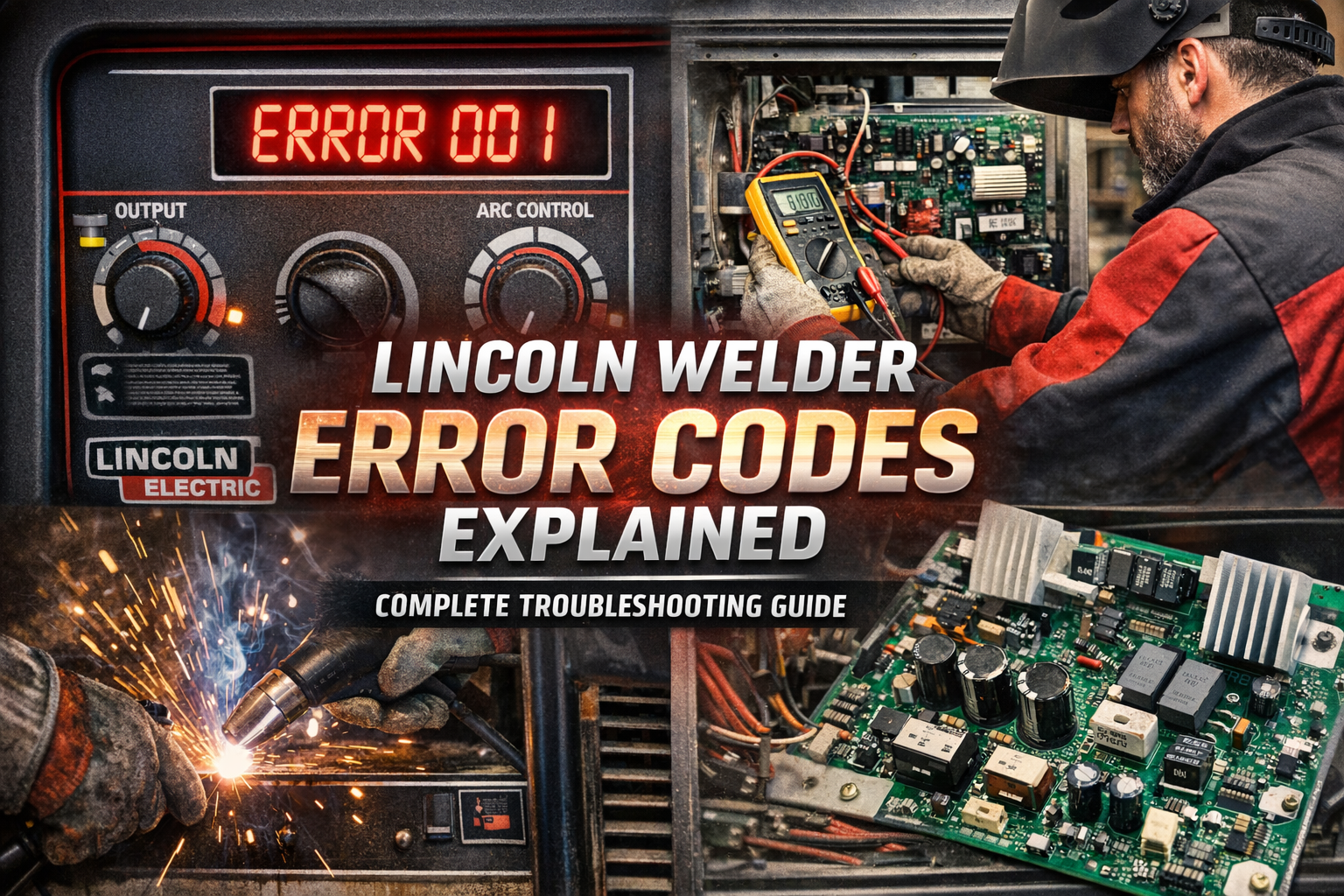
Lincoln Welder Error Codes Explained (Complete Troubleshooting Guide)
Modern welding machines from Lincoln Electric are highly reliable, but like any advanced electronic equipment, they rely on internal sensors, control boards, and protection circuits to operate safely. When something goes wrong, the machine often displays an error code to help identify the problem.
Understanding these error codes can:
- Reduce downtime
- Prevent unnecessary part replacement
- Help you decide whether it’s a simple fix or a professional repair
In this guide, we’ll explain the most common Lincoln welder error codes, what causes them, and how they’re typically resolved.
Why Lincoln Welders Display Error Codes
Lincoln machines continuously monitor:
- Input voltage
- Output current and voltage
- Temperature of internal components
- Fan operation
- Control board communication
If a reading goes outside the acceptable range, the machine protects itself by triggering a fault code or shutting down welding output.
Think of error codes as early warnings - ignoring them can lead to expensive failures later.
Categories of Lincoln Welder Error Codes
Most Lincoln error codes fall into these groups:
- Thermal / Overheating Errors
- Input Power Errors
- Output Circuit Errors
- Control Board / Communication Errors
- Fan & Cooling Errors
Let’s break these down.
🔥 Thermal & Overheating Error Codes
These indicate internal temperature has exceeded safe limits.
Common Causes
- Blocked airflow vents
- Failed cooling fan
- Excessive dust inside machine
- Operating beyond duty cycle
- Hot environment
Typical Symptoms
- Welding stops but machine stays powered
- Thermal light illuminated
- Error code related to temperature
What You Can Check
- Power off machine and let it cool 15–30 minutes
- Inspect vents for blockage
- Verify fan spins freely
- Clean dust using dry compressed air
When It’s Likely a Professional Repair
- Fan not running
- Thermal sensor faulty
- Power module overheating under normal load
Ignoring thermal errors often leads to IGBT or rectifier failure, which is far more expensive than fixing airflow problems early.
⚡ Input Power & Voltage Error Codes
These relate to incoming electrical supply.
Common Causes
- Low or high line voltage
- Phase imbalance (3-phase machines)
- Loose input connections
- Damaged power cord
- Undersized generator
Typical Symptoms
- Machine powers on then faults
- No weld output
- Error code appears immediately at startup
What You Can Check
- Measure input voltage at receptacle
- Confirm correct input jumper settings
- Inspect plug and cable for overheating
Professional Diagnostics
Technicians load-test the welder while measuring voltage drop, which often reveals hidden wiring or internal rectifier issues.
🔌 Output Circuit Error Codes
These indicate problems delivering welding current.
Common Causes
- Failed output rectifier diodes
- Contactor failure
- Loose internal bus connections
- Current sensor failure
Typical Symptoms
- Machine runs but no arc
- Erratic welding output
- Error code after striking arc
What You Can Check
- Inspect work clamp and electrode cable
- Check polarity connections
- Look for burned connectors
Professional Repair
Output circuits are high-current systems. Diagnosis involves:
- Diode testing
- Resistance measurements
- Dynamic load testing
Incorrect testing can damage boards, so this is usually a service-center job.
🧠 Control Board / Communication Error Codes
These occur when internal boards fail to communicate properly.
Common Causes
- Failed control PCB
- Corrupted firmware
- Voltage spikes
- Liquid or condensation damage
Typical Symptoms
- Random error codes
- Frozen display
- Settings won’t change
- Machine dead with display on
What You Can Try
- Power cycle machine
- Disconnect accessories (remote, wire feeder)
- Inspect for moisture
Professional Solutions
- Board-level diagnostics
- Firmware reload
- Board repair or replacement
Control board issues are among the most common high-value repairs in modern welders.
🌬️ Fan & Cooling System Error Codes
These indicate cooling airflow problems.
Common Causes
- Failed fan motor
- Obstructed fan blade
- Damaged fan wiring
- Faulty fan sensor
Typical Symptoms
- Fan never turns on
- Thermal error shortly after startup
- Fan-related error code
Why It Matters
Even if the machine still welds, lack of airflow drastically shortens component life.
Error Code TypeWhat It Usually MeansThermal / TempOverheating detectedInput VoltageSupply voltage out of rangeOutput FaultPower circuit problemFan FaultCooling system failureComm FaultBoard communication error
If you provide your machine model and code, a technician can often narrow the issue in minutes.
Resetting a Lincoln Error Code – Does It Fix the Problem?
Sometimes.
If the cause was temporary (overheating, low voltage), the code may clear after:
- Powering off
- Waiting 5 minutes
- Restarting
If the code returns, resetting alone does not fix the underlying problem.
Repeated resets can worsen damage.
Preventive Maintenance That Reduces Error Codes
- Quarterly internal cleaning
- Annual electrical inspection
- Fan operation test
- Torque check on internal connections
- Calibration verification
- Input voltage measurement under load
Shops that follow preventive maintenance experience far fewer sudden failures.
When to Call a Welding Machine Technician
Call for service if:
- Same error repeats
- Machine has no output
- Breakers trip
- Burning smell or unusual noise
- Fan not running
Early diagnosis often saves thousands in parts.
Professional Lincoln Welder Diagnostics in Toronto & GTA
At Link Technical Arc Services, we specialize in:
- Lincoln welder error code diagnostics
- Board-level repair
- Output circuit repair
- Cooling system repair
- Calibration & testing
- Onsite and shop service
We service fabrication shops, manufacturers, and industrial facilities across Toronto and the GTA.
Need help now?
Contact Link Technical Arc Services to schedule professional diagnostics and get your welder back in production fast.

.jpg)


.png)
© Copyright 2025 Link Technical Arc Services, all rights reserved.