

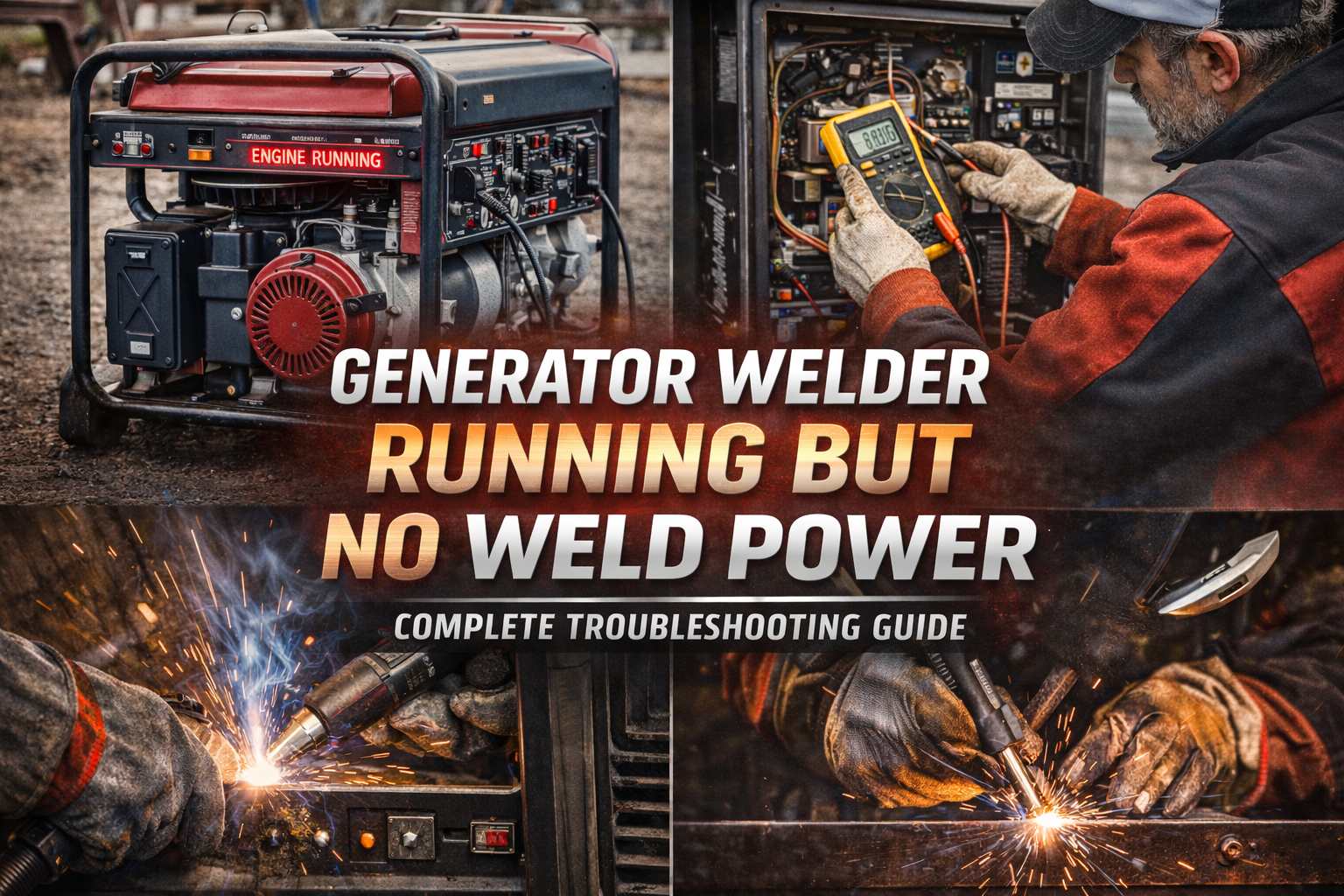
Generator welders combine an engine-driven generator with a welding power source, making them indispensable for construction sites, pipeline work, and mobile fabrication. Machines from manufacturers like Lincoln Electric, Miller Electric, and ESAB are designed for reliability — but even the best machines can develop faults over time.
One of the most frustrating issues operators encounter is:
The generator welder starts, runs smoothly, but produces no weld output.
The engine sounds fine. Auxiliary power may work. But when you strike an arc — nothing happens.
This guide explains the most common causes of this problem, what you can safely check, and when professional diagnostics are required.
What “Running but No Weld Power” Usually Means
This condition typically indicates that:
- The engine and generator section are operating
- The welding output circuit is not delivering current
In other words, the problem is almost never fuel-related. It’s almost always electrical.
Think of the machine as two major systems:
- Engine / Generator System
- Welding Power & Control System
If System #2 fails, you’ll get exactly this symptom.
Common Root Cause Categories
Most cases fall into one of these groups:
- Output contactor problems
- Failed rectifier or IGBT modules
- Control board or excitation issues
- Mode / control settings errors
- Current sensing or protection faults
- Wiring and connection failures
Let’s walk through each.
The output contactor is a heavy-duty internal relay that connects the welding power to the output studs.
What Happens When It Fails
- Machine runs normally
- Display looks normal
- No welding current reaches cables
Why Contactors Fail
- Worn contacts
- Burned coils
- Carbon buildup
- Overheating
What You Can Check
- Listen for a “click” when triggering weld output
- Inspect for burned smell near output terminals
- Verify output studs are tight
Professional Test
Technicians measure coil voltage and check contact resistance. If contacts are pitted or open, replacement is required.
Failed Rectifier or Power Module
Generator welders convert AC generator power into DC welding output using rectifiers or IGBT modules.
What Happens When These Fail
- No output at all
- Weak or unstable arc
- Fault codes on some models
Common Causes
- Age and heat stress
- Poor ventilation
- Power surges
- Repeated overheating
Symptoms
- Machine runs but no weld
- Sometimes auxiliary power still works
- Breakers may trip intermittently
Why This Is Not DIY
Power modules handle very high current. Incorrect testing can damage control boards or cause injury.
Loss of Excitation
Excitation creates the magnetic field necessary for welding output.
Causes
- Failed excitation board
- Broken excitation wiring
- Control PCB fault
Symptoms
- Zero open-circuit voltage
- No arc initiation
- No error displayed on older models
Technicians verify excitation voltage using meter tests and schematics.
Mode or Control Setting Issues
Sometimes the problem is simple.
Check These First
- Welding mode (Stick / TIG / Wire)
- Remote vs panel control
- Amperage not set to zero
- Polarity correct
- Arc control not disabled
A wrong mode selection can completely disable output.
Faulty Current Sensor
Modern machines monitor output current using sensors.
If the sensor fails:
- Machine may think there is a short
- Output is disabled
- Fault codes may appear
This commonly requires sensor replacement and calibration.
Wiring & Connection Failures
High vibration from engine-driven units stresses wiring.
Common Problem Areas
- Output cable lugs
- Internal bus bars
- Harness connectors
- Ground straps
Loose or burned connections create open circuits that stop output.
Thermal Protection Triggered
If internal temperature exceeds limits:
- Machine disables weld output
- Engine continues running
Causes
- Plugged cooling vents
- Failed fan
- Dirty heat sinks
Let the machine cool and check airflow. If it repeats, internal service is required.
Step-By-Step Troubleshooting Flow
- Verify correct welding mode
- Check amperage setting
- Inspect output cables & connections
- Try different polarity
- Power off → wait 5 minutes → restart
- Listen for contactor click
- If still no output → professional diagnostics
This simple flow solves many field issues.
Can You Keep Running the Machine?
Running a generator welder with no output does not usually damage the engine, but it can:
- Overheat failed components
- Damage control boards
- Turn a small repair into a large one
If output is gone, stop welding operations and investigate.
Examples include:
- Lincoln Ranger & Vantage series
- Miller Trailblazer & Bobcat series
- ESAB Ruffian & Warrior series
The troubleshooting logic is similar across brands.
Why Professional Diagnostics Matter
Modern generator welders are electronically complex.
Technicians use:
- Load banks
- Isolation transformers
- Oscilloscopes
- Manufacturer schematics
- Known-good test components
This allows fast isolation of the failed stage instead of random part swapping.
Random replacement often costs more than proper diagnosis.
Typical Repairs for This Symptom
- Contactor replacement
- Rectifier / IGBT module replacement
- Control board repair or replacement
- Sensor replacement
- Harness repair
- Cooling system service
Once repaired, machines should be load-tested and calibrated.
Preventive Maintenance That Prevents Output Failure
- Quarterly internal cleaning
- Annual electrical inspection
- Fan operation test
- Torque check on power connections
- Calibration verification
- Duty-cycle compliance
Shops that follow preventive maintenance experience far fewer breakdowns.
When to Call a Welding Machine Technician
Call for service if:
- No arc at all
- Output intermittent
- Burning smell
- Breakers trip
- Fault codes present
- Machine recently overheated
Early repair saves money.
Generator Welder Repair in Toronto & GTA
At Link Technical Arc Services, we specialize in:
- Generator welder diagnostics
- Output circuit repair
- Contactor replacement
- Power module repair
- Control board repair
- Calibration & testing
- Onsite and shop service
We support fabrication shops, contractors, manufacturers, and industrial facilities across Toronto and the Greater Toronto Area.
Need help fast?
Contact Link Technical Arc Services to schedule professional diagnostics and get your generator welder back in production.

.jpg)


.png)
© Copyright 2025 Link Technical Arc Services, all rights reserved.